
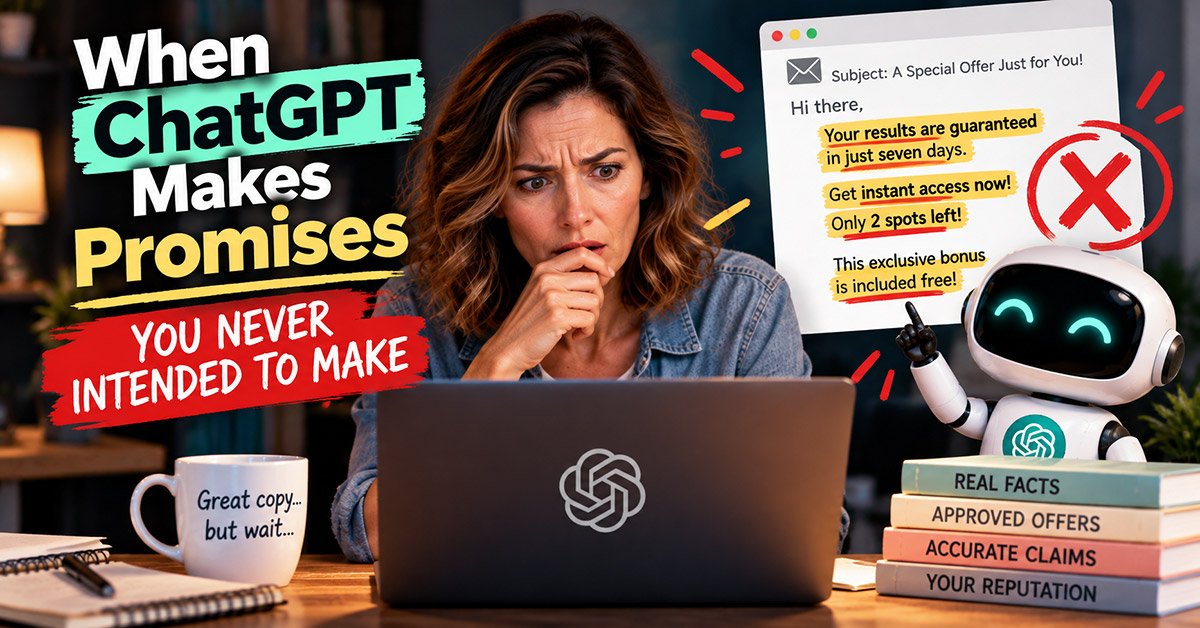
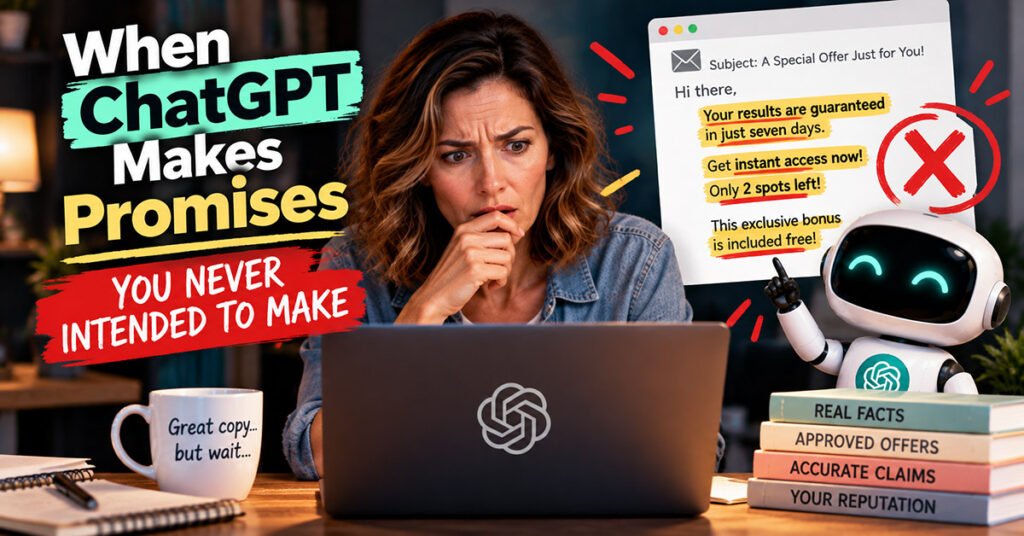
What if ChatGPT Makes Promises You Never Intended to Make?
Imagine you’ve asked ChatGPT to write a promotional email for your new product.
You give it the main details, explain who the product is for, and ask for a persuasive email that will make people interested.
A few seconds later, you’ve got a beautiful draft. Great headline, logical structure, convincing benefits, and a strong call to action.
Looks perfect, right?
Well, almost.
Somewhere in the middle, you notice a sentence that says:
“Your results are guaranteed in just seven days.”
Wait a minute. Who guaranteed that?
You certainly didn’t. And your product doesn’t come with such a promise either.
But there it is, sitting inside an otherwise excellent email, looking like it belongs there.
Now imagine you hadn’t noticed it and sent the email to your subscribers.
Congratulations. You’ve just promised something you can’t deliver. Yes, ChatGPT makes promises sometimes that are impossible to deliver.
And this is one of the problems with using AI for marketing that doesn’t get nearly enough attention.
AI Can Write Convincingly About Things That Don’t Exist
We all know ChatGPT can make mistakes. We’ve heard about hallucinations, invented references, and incorrect answers.
But when we’re using it to write marketing content, the problem can be much more subtle. ChatGPT makes promises in your name.
It’s not necessarily going to invent an entirely new product. Instead, it might add a little something that makes your offer more appealing.
For example:
- A bonus you never intended to include.
- A discount that doesn’t exist.
- A deadline nobody approved.
- A claim that only a few places remain.
- A feature that’s still being developed.
- A promise about results you have no way of guaranteeing.
And here’s the interesting part.
These additions often make the copy sound better.
They create urgency, make the offer seem more valuable, or remove objections that might prevent someone from buying.
Which is exactly why they’re so dangerous.
You’re reading a well-written sales message, your brain is following the argument, and suddenly that invented bonus or guarantee doesn’t look suspicious anymore.
It looks like good marketing.
Until someone buys based on that promise and expects you to deliver.
That’s when your little copywriting shortcut becomes a customer support problem.
Or worse, a trust problem.
Start With Facts, Not With a Prompt
There’s a simple way to reduce these mistakes, and it starts before you ask ChatGPT to write anything.
Prepare a list of facts that are actually true about your offer.
I know. Not particularly exciting.
We want AI to save us time, not give us more paperwork, right?
But think about it for a moment.
If you give ChatGPT a vague description and ask it to make the offer more attractive, what exactly do you expect it to do?
It will try to make the offer more attractive.
And if the information is incomplete, it may fill some gaps with details that sound reasonable.
That’s not what you want.
For every product or promotion, prepare a short reference document containing the important details:
- Product name: The exact name you want to use.
- What’s included: Features, modules, files, services, or bonuses.
- Price: The actual price and any confirmed discounts.
- Dates: Launch dates, deadlines, workshop dates, or delivery schedules.
- Delivery: How and when customers receive what they buy.
- Conditions: Eligibility, limitations, and refund terms where relevant.
- Next step: What happens after someone clicks your link or places an order.
Then separate confirmed information from things you’re still considering.
Let’s say you’re planning a live workshop.
You’ve decided to limit attendance to twelve participants because that’s how many people one instructor can reasonably support.
Fine. That’s a real limitation, assuming you’ve confirmed the number.
But there’s a difference between:
“The workshop is limited to twelve participants.”
And:
“Hurry! Only two places left!”
The first statement describes the workshop’s capacity.
The second claims something about current availability.
Unless you’ve actually checked the registrations, you have no business making that second claim.
And ChatGPT shouldn’t make it for you.
Tell ChatGPT What It Must NOT Do
Most people spend their time telling AI what they want.
Write a persuasive email. Make the headline stronger. Add urgency. Improve conversions.
All reasonable requests. But sometimes it’s equally important to explain what it must leave alone.
For example, I would add this to the instructions:
Use only the product facts provided in this brief. Do not invent bonuses, discounts, deadlines, testimonials, scarcity claims, guarantees, features, or customer results. If important information is missing, flag it instead of making an assumption.
Simple enough.
Will this prevent every mistake?
No.
But it establishes an important boundary between improving the presentation and changing the offer itself.
ChatGPT can rewrite your message. It should not rewrite your business commitments.
And you still need to inspect what it produces. Because, even with everything inluded, ChatGPT makes promises sometimes.
Not All False Promises Contain Numbers
When checking a draft, it’s easy to focus on obvious details.
Prices. Dates. Percentages. Product names. The number of lessons or bonuses.
Those are important, of course.
But some of the most troublesome claims contain no numbers at all.
Consider these:
“Anyone can do this.”
“You’ll get results.”
“Works for every business.”
“Your account will be ready instantly.”
Sounds familiar?
These are the kinds of statements that appear in marketing copy all the time.
But can you actually support them?
Suppose you’re selling a digital guide. Customers pay, and the download becomes available immediately.
In that case, saying they receive instant access may be perfectly accurate.
Now suppose you’re selling a consultation that requires you to review an application and arrange an appointment.
Instant access? Not quite.
The same applies to booking processes.
“Request your booking” means someone submits a request.
“Book your place instantly” suggests the booking is confirmed immediately.
Those are two different things, and customers may make plans based on the wording. The problem isn’t limited to guarantees or dramatic income claims.
Even a small change in wording can create a promise you never intended to make.
Check What Happens After the Click
This is something I would pay particular attention to, especially in affiliate marketing.
We’ve probably all seen promotions promising instant downloads, free access, special bonuses, or immediate membership activation.
But what happens after someone actually clicks the link?
Does the customer really get immediate access?
Is the product free, or is there a free trial?
Does the advertised bonus come with the purchase, or does the customer have to claim it separately?
Does a booking happen automatically, or is there an approval process?
These are not minor details. They’re part of the offer.
And if you’re promoting somebody else’s product, you’re not necessarily in control of any of them.
The vendor may change the price. Remove a feature. Update the refund policy. Replace a bonus.
Your old description may no longer be correct.
That’s why I recommend checking the current vendor page and relevant terms before publishing a new affiliate promotion.
Don’t assume that something you promoted three months ago is still exactly the same today.
And don’t let ChatGPT turn something the vendor might provide into something you’re personally promising.
If you don’t control delivery, refunds, or support, your copy shouldn’t suggest otherwise.
What About Testimonials and Success Stories?
Here’s another potential problem.
You ask ChatGPT to make your sales page more persuasive, and it creates a wonderful customer story.
Someone bought your product, followed the process, and achieved an impressive result.
The story sounds realistic. It illustrates the benefits perfectly.
There’s just one small problem.
That customer doesn’t exist.
Now, there’s nothing wrong with using fictional examples to explain how something works.
For instance, you could describe how a hypothetical marketer uses your checklist to compare several affiliate offers before choosing one to promote.
That’s an educational example.
But putting quotation marks around an invented success story and presenting it as a real customer’s experience?
That’s a different matter.
Testimonials should come from actual customers, reflect experiences you can verify, and be used with appropriate permission.
If you don’t have any, don’t manufacture them.
And if ChatGPT invents one, remove it.
A sales page without testimonials is much better than one containing fake testimonials.
Give Important Claims Something to Stand On
For larger campaigns, I like the idea of keeping a simple verification sheet.
Nothing complicated.
Just two columns.
One contains the claim you’re making. The other tells you where that information came from.
For example:
| Claim | Verification source |
|---|---|
| Includes three editable worksheets | Current product files |
| Workshop takes place on October 17 | Confirmed event schedule |
| Twelve places available | Approved workshop capacity |
| Immediate access after purchase | Tested delivery process |
| Saves customers two hours | Supporting evidence required |
Notice the last example.
“Saves customers two hours” sounds like a nice benefit.
But unless you have a reasonable basis for saying that, it’s just an assumption dressed up as a result.
You could instead explain what the product actually helps people do.
For example:
“Use the checklist to compare affiliate offers against five important criteria before deciding which one to promote.”
That’s clear. It describes the process. And it doesn’t promise that anyone will earn a commission or save a specific amount of time.
If you can’t verify a claim, you have three options:
- Remove it.
- Rewrite it so it accurately reflects what you know.
- Find supporting evidence before using it.
There’s no fourth option where you simply trust the AI because the sentence sounds good.
Watch Out for These Little Words
Some words deserve extra attention when you’re reviewing marketing copy.
Guaranteed. Always. Everyone. Only. Instant. Never.
They look harmless enough, but they can completely change the meaning of a statement.
For example:
“We aim to respond within one working day.”
Sounds reasonable if that’s your normal support target.
Now let ChatGPT make it more persuasive:
“We respond instantly!”
See the problem?
The new version sounds stronger, but it describes a completely different service level.
The same happens with scarcity.
“Registration closes on Friday” is fine when Friday is the actual deadline.
“Registration closes forever on Friday” is a much bigger claim.
And “only two copies left” makes very little sense for a digital product unless there’s a genuine sales restriction behind it.
So whenever you see these absolute words, ask yourself one question:
Can I actually stand behind this statement?
If the answer is no, change it.
Old Information Can Be Just as Dangerous as Invented Information
Not every incorrect claim comes from ChatGPT making something up.
Sometimes the problem is the information you gave it.
Think about a product launch.
You prepare a sales page, several emails, a few social posts, and perhaps an affiliate bonus page.
Everything is based on the same product details.
Then the vendor changes the launch date.
Or the price.
Or the bonus package.
What happens to all those drafts?
Nothing, unless you update them.
And if you later give ChatGPT one of those old drafts as a reference, it may faithfully repeat the outdated information.
Perfect writing. Wrong facts.
That’s why I recommend maintaining one approved product sheet and updating it whenever something changes.
If you’re working with other people, let one person handle the final approval of changes.
Otherwise, a bonus mentioned casually during a meeting can suddenly appear as an official promise in an email.
And once that email reaches your subscribers, explaining that it was “just an idea” won’t help much.
When an important detail changes, tell ChatGPT exactly what has changed and ask it to find every mention of the old information across your drafts.
Then update the actual campaign assets.
And remember something important.
ChatGPT saying “updated” doesn’t mean your website, autoresponder, or scheduled social posts have changed.
Unless you’ve connected and authorized a tool capable of making those changes, you’re still responsible for updating the published material.
Can GPT-6 Catch More Mistakes Than GPT-5.6?
This brings us to the model selection question.
For a simple product description with a short list of approved facts, GPT-5.6 may be perfectly adequate.
Give it a proper brief, let it prepare the copy, and check the result yourself.
But what if you’re building an entire campaign?
Several sales pages. Different product tiers. Multiple prices. Bonuses. Deadlines. Email sequences. Social posts.
Suddenly, keeping everything consistent becomes a bigger job.
That’s where I would consider testing GPT-6 for the review process.
Give it the approved product sheet together with all the drafts, and ask it to identify inconsistencies, unsupported promises, and conflicting information.
You can even ask it to quote the exact sentences that need checking.
Of course, don’t assume that a more capable model will automatically catch everything.
It may identify problems the other model missed. It may also overlook something important.
And the practical model recommendations in my ebook are starting points, not conclusions from a controlled marketing experiment.
If you really want to compare them, use the same source documents and the same instructions.
Then compare the actual work involved in producing a publishable result.
Personally, I’d rather fix a boring headline than explain to a customer why my beautifully written sales page promised a bonus that doesn’t exist.
Wouldn’t you?
My Five-Minute Check Before Publishing
You don’t need an elaborate review system for every promotional email.
But you do need a habit.
Before publishing any AI-assisted marketing content, I would check five things:
1. Audience: Does the message speak to the right people without making unsupported assumptions about them?
2. Offer: Does it describe the correct product, package, and purchase conditions?
3. Facts: Are the names, prices, dates, bonuses, and features accurate?
4. Promises: Does the copy suggest results, guarantees, limitations, or service levels that haven’t been confirmed?
5. Next step: Does the reader know what actually happens after clicking the link?
That’s it.
Five checks that can prevent a surprising amount of trouble.
And this isn’t just about ChatGPT.
The same approach works when you’re reviewing copy written by a freelancer, a member of your team, or yourself at two in the morning.
Mistakes happen.
What matters is catching them before your customers do.
It’s vital to yout credibility that you stop it when ChatGPT makes promises.
The Real Goal Isn’t Perfect Copy
We use ChatGPT because it can make content creation faster and easier.
And it does.
But speed doesn’t mean much if you have to spend the next three days correcting customer expectations created by one inaccurate email.
Nor does a beautifully written sales page help if the offer it describes isn’t the one you’re actually selling.
The goal is to produce useful, persuasive marketing content that people can trust.
If GPT-5.6 does that consistently for your usual tasks, there’s no reason to switch simply because a newer model exists.
If a more complex campaign keeps producing inconsistent details, give GPT-6 a try and compare the results.
Just remember that neither model knows your business commitments better than you do.
Let AI improve how you communicate your offer. Don’t let it invent what you’re offering.
That’s a much better way to use it.
And if you’re deciding which model makes the most sense for your everyday marketing work, my ebook Choosing GPT-6 or GPT-5.6 for Everyday Marketing explains where each may be useful, what to compare, and what you should still check before publishing. Plus, you get it with PLR rights so you can sell it yourself and keep 100% of the profits.




0 Comments