


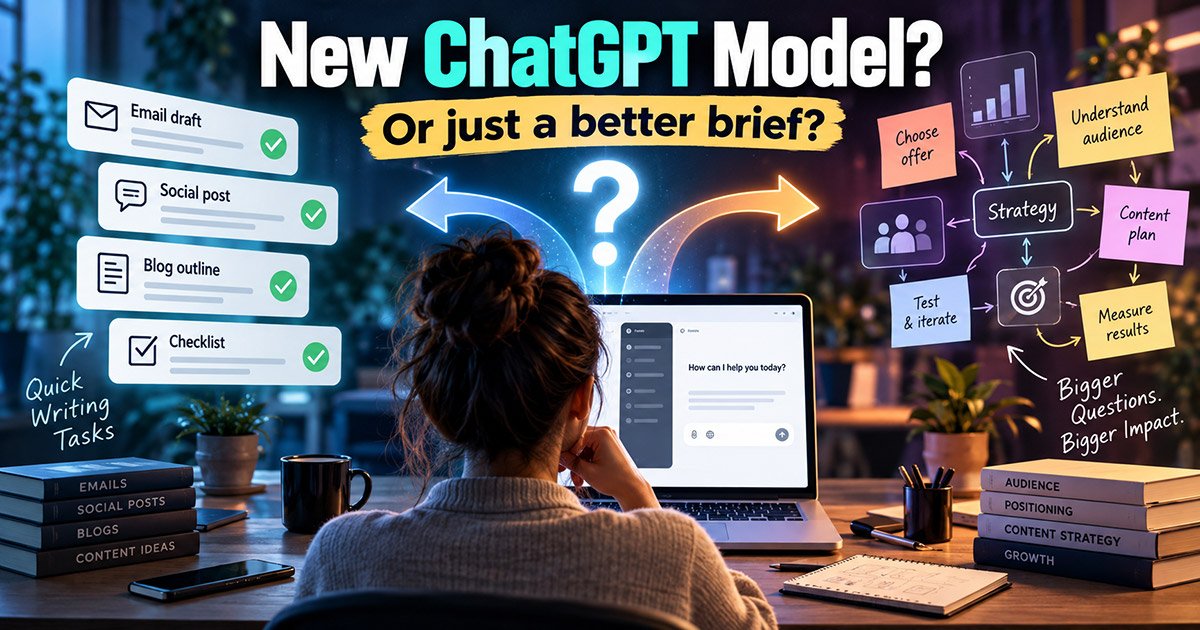
There’s a new ChatGPT model available
A new model appears in your ChatGPT menu. You have a newsletter due, three posts to write, and a sales page that still needs work. The obvious question is: Should you switch to this new GPT model or try with the old one?
It is a fair question. Nobody wants to spend another hour fixing a draft if a different model could get it right sooner. Yet switching just because the number is higher can add one more decision to an already crowded day. What matters is the work you need to finish.
Imagine that you have approved a weekend offer. The price, deadline, product details, and audience are settled. Your task is to turn that information into a short email and two posts. You can describe what you need in a few sentences. If GPT-5.6 gives you clear drafts that need only light editing, you have your answer for this job. Send the email and move on.
Now imagine you have not chosen the offer. You have customer questions, several possible bonuses, a small list, and limited time to deliver what you promise. The email is the last piece of the puzzle. First, you need to decide which offer fits the audience and what claims you can support. That is the kind of task where it makes sense to try GPT-6 and compare the result with your usual model.
Ask what kind of help you need
A useful distinction is between writing around a decision and helping you make one. When you already know what to say, the work is contained. When you are still weighing options, each choice affects the next one. The audience affects the promise. The promise affects the page. The page affects the email. A misunderstanding early on can travel through the entire campaign.
This does not mean GPT-6 will always write a stronger subject line or that GPT-5.6 cannot help you plan. The ebook treats these as starting points to test, not guarantees. Your business, brief, and definition of a usable result matter. A plain email your customers understand is worth more than a clever one that needs extensive correction.
Take a simple reminder email. Perhaps a workshop begins on Tuesday, and registered attendees need the address, start time, parking details, and a note about what to bring. Give ChatGPT the confirmed information. Ask for a friendly message under 150 words. Check every fact. You probably do not need an elaborate model comparison for this task.
Take a product launch with two audiences. Existing customers know the brand; new subscribers do not. One group qualifies for an upgrade, while the other needs the standard offer. The launch page, email sequence, and social posts must agree on dates and terms. Here, the cost of mix-ups is higher. You have a better reason to test which model helps you keep everything straight.
A ChatGPT model cannot supply missing business facts
Before changing Chatgpt models, look at your instructions. Did you say who the reader is? Did you include the real price and deadline? Did you explain what is included? Did you name the action readers should take? If those details are missing, either model may make assumptions you dislike. A stronger model is not a substitute for a clear brief.
Try writing a short source sheet for your next content task. Put the audience, offer, approved claims, dates, restrictions, desired tone, and link destination on one page. Mark uncertain details as uncertain. Then use that same sheet with whichever model you try. A clear source gives you an honest way to judge the draft.
For example, “Write a persuasive email about my course” leaves too much open. “Write a 180-word email to people who downloaded my beginner checklist; invite them to a live class on Thursday; use the confirmed details below; do not invent bonuses or results” gives the writer a job it can actually complete. The quality difference may come from that change alone.
Compare the finished task, not the first impression
A polished opening can make one draft look better at first glance. Keep reading. Does it speak to the right audience? Does it preserve the price? Does it avoid promising an outcome you cannot guarantee? Does the call to action match the page you will send people to?
When both models are available, run one real task through each using the same brief. Set a few requirements before you read the answers. Record the edits needed to publish each version and roughly how long they take. An invented deadline should count heavily, even if the rest of the copy sounds appealing. A shorter, plainer draft may be the better business choice when it can be approved faster.
You do not need to test every post. Start with one routine task and one difficult one. If your usual model handles the routine job well, keep using it. If the more involved task repeatedly loses important details, compare it. This small test can lead to a practical routine instead of a new argument with yourself every time you open ChatGPT.
Make the choice easy to remember: Try one ordinary job this week
The next time you have a real email to send, write down the point of the message before opening ChatGPT. Include the facts and a sentence about who will read it. Draft with your usual model, then review it using a short checklist: audience, offer, accuracy, tone, and action. Note how many material changes you made. That becomes your baseline.
For a second task involving a harder decision, use the same method and compare the models if both are available. If you only have access to one, record where it struggles rather than paying for a different plan on impulse. If the problem is missing source material, supply it first. If it is repeated failure to hold several clear requirements together, a comparison becomes more worthwhile.
This small record gives you more than a general opinion about which model is “best.” It tells you how each one fits the jobs you do, where you spend time, and which errors have consequences. Revisit it when your work or available options change, not every time someone posts an impressive sample online.
For many marketers, a useful working habit is to start with GPT-5.6 when the facts and direction are already settled. Consider GPT-6 when several sources need to be combined, the audience or offer is still being decided, or related pieces have to stay consistent. Then let your own results refine that habit. You might prefer one model for planning and the other for short drafts. You might find that one familiar option meets almost all your needs.
Also separate model choice from a subscription decision. Access and usage limits can differ by account and can change. Check the options actually shown to you before paying for a plan on the strength of a general comparison. The question to ask is whether any improvement saves enough real work to matter for you.
The goal is not to become an expert in model names. It is to finish good content with fewer preventable mistakes. Once the writing is approved, you should be able to close the tab and get on with the rest of your business.
If you would like a plain-language way to make that choice, get Choosing GPT-6 or GPT-5.6 for Everyday Marketing.
It walks through emails, posts, sales pages, planning, and a simple test you can use with your own work. Get the ebook here.





0 Comments